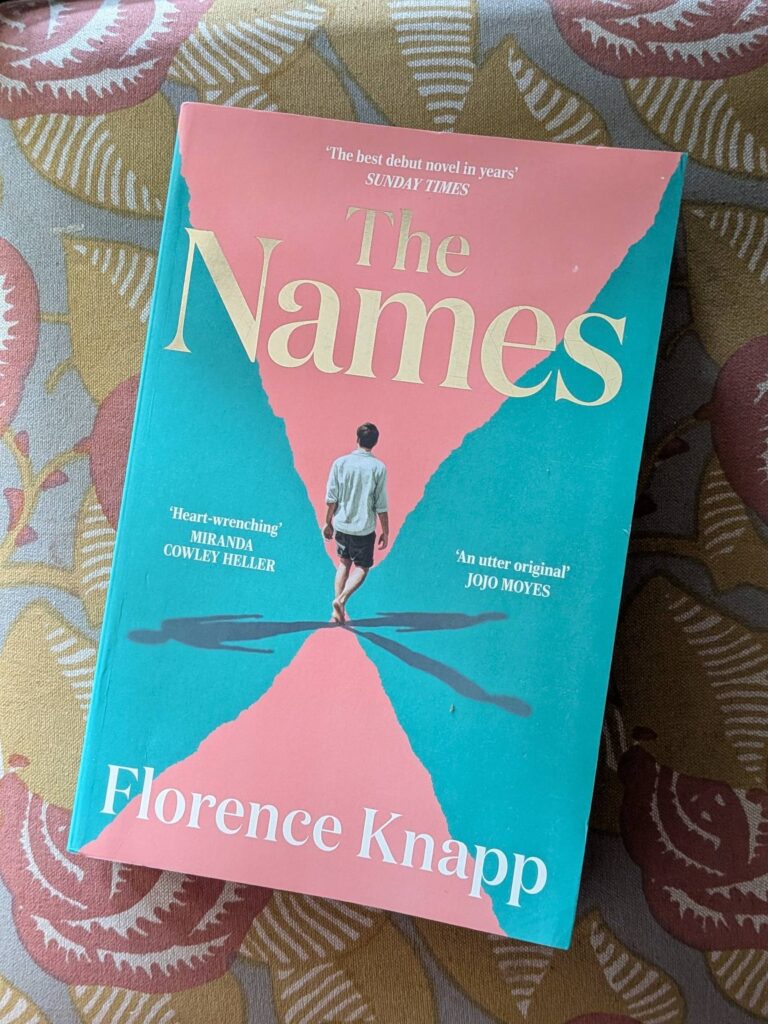
I have a thing for what-if scenarios, and that’s one of the reasons I loved The Names. I remember at least two occasions when they happened in a literary work – the first was a Hardy Boys + Nancy Drew book that asked you to turn to a particular page depending on the option you chose from the possible outcomes, and the second was a Jeffrey Archer short story (One Man’s Meat) which had Rare, Burnt, Overdone, and À Point endings!
In The Names, Florence Knapp creates three scenarios based on a single choice – registering the naming of a baby. From there, three pathways open – parallel lives of different people in the family that follow separate trajectories across three decades.
In terms of narrative, the book is structured as the state of the characters in a particular timeline and then taking seven-year leaps. This did force me to go back a few times to reorient myself, but it didn’t really bother me a lot. In fact, it helped me pay attention and recollect the small touches that show patterns, and sometimes notice a version of what happened in some other timeline.
The book somehow manages emotional depth while maintaining a brisk pace, and balancing it with a natural amount of unevenness across three different timelines in terms of character depth and arcs. The subject is not a pleasant one, and that requires some complicated work across the internal dialogues of all concerned (x 3). Not to mention getting the involvement of characters other than the key ones just right. Neither are easy tasks to accomplish.
What I really liked about The Names is that in addition to being a great story, it is also a thoughtful, mindful and emotionally aware reflection on choice and consequence.
Stasiland had me hooked on Page 4, when Anna Funder nailed (in the GDR context) my fascination – why I keep reading about (and visiting) Eastern Europe. She calls it horror-romance. “The romance comes from the dream of a better world the German Communists wanted to build out of the ashes of their Nazi past: from each according to his abilities, to each according to his needs. The horror comes from what they did in its name.“
After WW 2, when the victorious Allies were divvying up the spoils, Russia began directly controlling the Eastern part of Germany, and in 1949, GDR was established as a satellite state of the USSR. The rhetoric of Communist brotherhood was established, which had liberated East Germans from fascism. The idea was to project GDR as those who were the innocent of Nazism, and that all the Nazis had gone to West Germany! The GDR, in its 40 years of existence tried to create a Socialist German Man, different from Nazi German Man, and from western (Capitalist Imperialist) German Man.
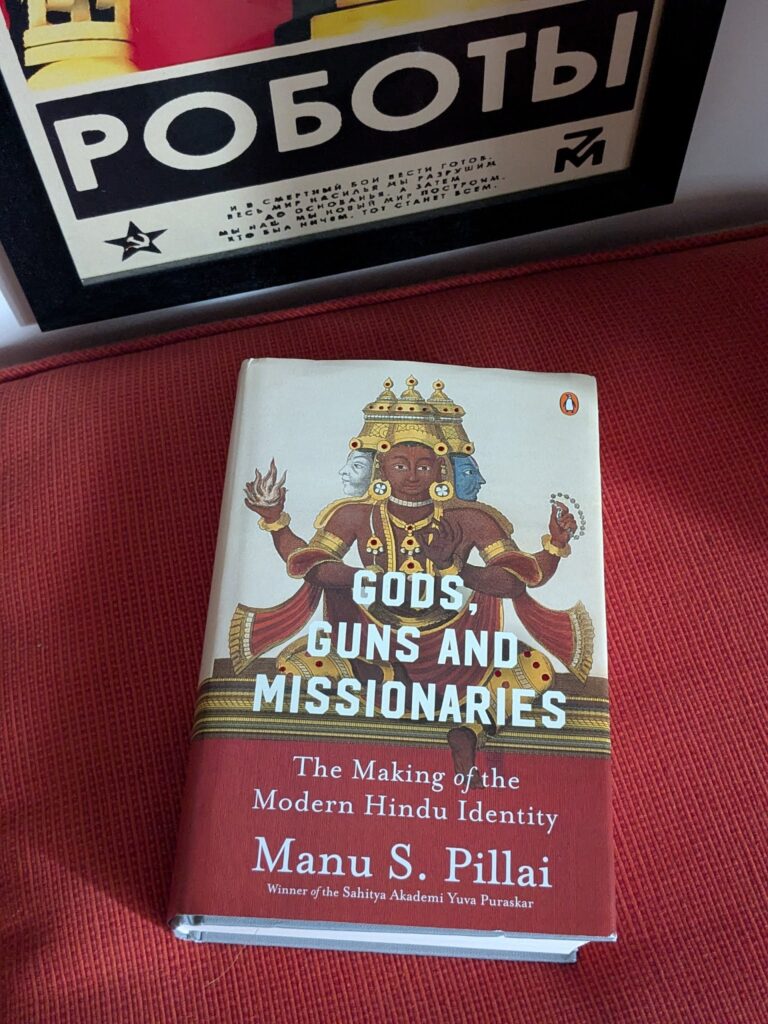
The alternative title of Gods, Guns and Missionaries should be Bharat Ek Khoj – the Hindu Nationalism edition. But seriously, the amount of research that seems to have gone into this book is staggering – over 220 pages of this 549 pager consist of Notes.
In some ways, it is a study of Hindu culture, seen through the perspectives of rulers and politicians, both Indian and European, and philosophers, missionaries, and revolutionaries, juxtaposed against ground reality, but if one had to pick a thread through the chapters, it would be the study of the dynamics across history (till Independence, not contemporary, smart choice for many reasons) that led to the Hindu nationalism we now see.
The seven chapters of Gods, Guns and Missionaries span centuries, regions, and worldviews, switching between political, spiritual, and cultural currents and combining archival detail, anecdotal richness, and contemporary relevance. The evidence of the first two is right in the first page, in the story of the maharaja of Jaipur attending the coronation of King Edward VII in London in a steamer, with cows!
From then on, the book, through about four centuries, traces the evolution of Hindu identity from the late medieval period up to the early 21st century, highlighting the political, religious, and cultural developments that shaped modern Hinduism as a more defined, self-conscious identity.
The central theme of the book is that Hinduism has never really been a monolithic concept. In fact, it has thrived precisely because it was malleable – argued over, enriched and transformed in theology, ritual and identity, by contact with others. The early parts of the book is mostly about the rich and inherent diversity – what fascinated and caused bewilderment among early European missionaries.
Practices varied widely across geography and sects, with no centralised authority. This religious elasticity was critical to Hindu society’s resilience. The anecdote I mentioned earlier is interesting for this detail on adaptability too – the Jaipur maharaja’s ship had an idol that the priests kept onboard so that the Raja wouldn’t technically violate the taboo against crossing the seas.
Towards the end of Gods, Guns and Missionaries, there is an excellent analogy. Five brown persons in a room – each a different shade from the other – might not view themselves as a single organism. They might even fight with each other. But when a white person enters the room, they become aware of their common features, and if under threat, the shared brownness becomes a means to mount a joint action. This assertion happens because of the context. And that is what happened with Islamic rulers and later with European missionaries.
These external pressures became the catalyst for a growing sense of communal identity. Muslim rule sharpened regional self-awareness among Hindus, and Christian missionaries, backed (inconsistently though) by the colonial rulers, pressed Hindus to consolidate a unified theological and ideological framework. Missionaries brought critiques: denouncing polytheism, idol worship, and caste-based inequality. The British East India Company initially viewed missionaries as distractions, but gradually, thanks to the influence of evangelical groups and reform-minded legislators, accommodated them to support a civilising mission, transforming Company policy.
Reformist Hindus responded playing and many a time winning arguments even according to the rules of the West- sometimes embracing monotheism, sometimes rejecting rituals. They used these critiques to reform or rebrand Hinduism into a perceived monotheistic core compatible with Enlightenment values. Rammohan Roy, Dayananda Saraswati, Jyotirao Phule are what the book calls ‘native Luthers’. Special mention for Serfoji II of Tanjore, really ahed of his time. They challenged tradition while shaping the contours of modern faith. Roy introduced the term “Hinduism” into modern discourse; Saraswati denounced idolatry and brought back Vedic teachings into the discourse; Phule attacked caste structures from within a reconstituted Hindu framework.
The final section – Drawing Blood – features the two men who really gave shape to the brand of Hindu nationalism we see today. The first, Bal Gangadhar Tilak, had an overlap of Hinduism and nationalism early in his career. Converting large religious festivals into mass political rallies, riding on Ganapati, pun slightly intended. For him, internal caste differences were no impediment, it was all one religion. Everyone else would only be ‘tolerated’. For critics, Tilak wanted nationalism, but without surrendering caste prerogatives. Tilak doesn’t come out looking good in the book. (read Notes)
The second – Vinayak Damodar Savarkar – the architect of modern political Hindutva. Savarkar clarified that Hindu-ness and Hinduism wasn’t the same. He unified cultural, racial, and religious identity into a nationalist ideology that deliberately drew boundaries between who was “in” and “out.” His criteria- India must be one’s fatherland, or the home of one’s ancestors, but it must be equally one’s “holy land”- hardened as he aged (partly because of the Muslim warders he dealt with in Andaman), but not only found emotional appeal, and , it now serves as the ideological foundation for the lotus kids.
Gods, Guns and Missionaries is a fascinating read on how, through several centuries of interactions and mutations, a kaleidoscopic, regionally diverse Hindu world gradually became a (relatively) more consolidated modern identity that is now being harnessed in politics. An excellent read because it is balanced in that it neither romanticises pre-colonial unity nor does it accept colonial narratives uncritically. In my 2025 Bibliofiles long list.
Notes from Gods, Guns and Missionaries
1. Brahmi was the ancestor to almost all Indian scripts 2. Hinduism’s evolution as per Savarkar was ‘a process of assimilation, elimination, and consolidation’ 3.The older portion of the Vedas are often called karma kanda (focused on sacrifice, rituals, and invocations). The vedanta is called jnana kanda – the repository of wisdom. 4. Jacob Rama Varma (1814-56) existed! 5. Tilak recommended that Pandita Ramabai restyle herself as reveranda – punning on reverend and randa (whore) 6. Tilak was once driven off stage once with tomatoes and eggs when he spoke against women’s rights, and tucking away intra-Hindu dissonances on caste
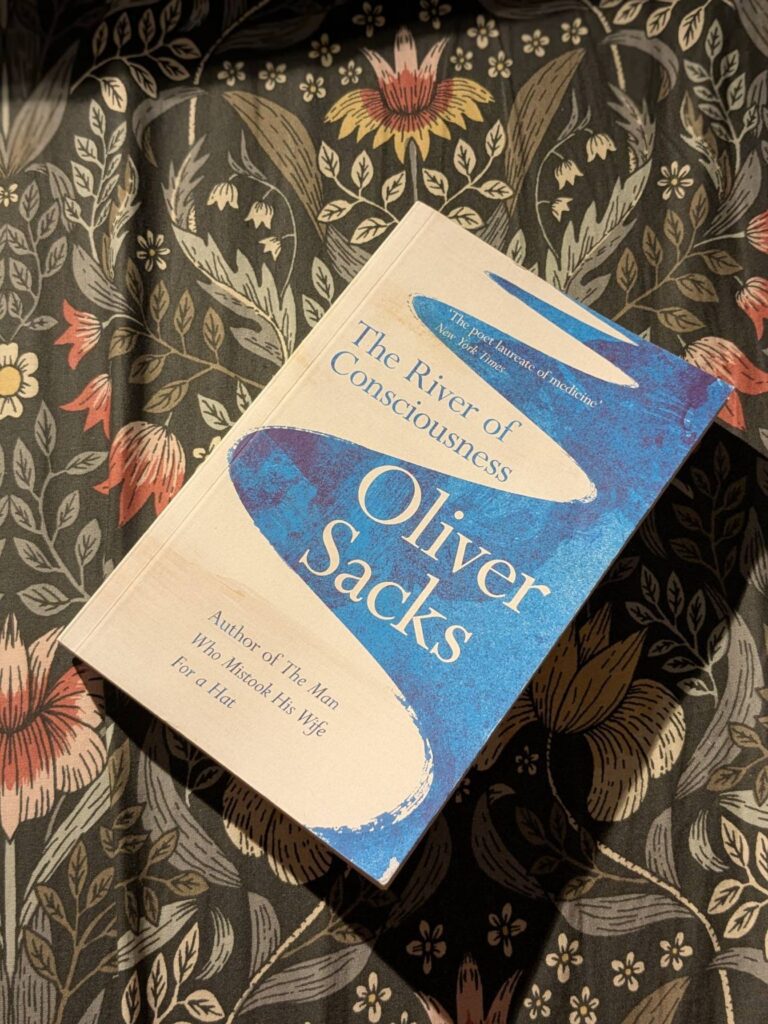
The River of Consciousness is the final collection that Oliver Sacks oversaw, assembled just two weeks before his death in 2015. Ten essays across diverse subjects such as botany, chemistry, evolution, medicine, neuroscience, and even the arts. They are connected by the title – an exploration of how the river of consciousness has moved through evolution, and how it continues to manifest itself in ways beyond what we normally look at.
While a large part of the book is objective, there are a few sections where the author’s own experiences and maladies become a trigger for investigations. I liked the former more, but the explorations across memory, time, creativity are all fascinating anyway.
He opens the ‘river’ with “Darwin and the Meaning of Flowers”, exploring Darwin’s relatively lesser-known botanical experiments, but showcasing his abundant curiosity – lying in grass pollinating flowers by hand, and celebrating plants as living entities imbued with purpose and beauty.
Darwin intuitively hypothesised that the tip of the plant’s root – radicle – behaves like a brain for lower animals, receiving sensory impressions and directing several movements. Criticised at that point, it was proven right fifty years later, and plant hormones like auxins were discovered.
The next essay, “Speed”, is about how our brains distort time, whether slowed by Parkinson’s or quickened by Tourette’s and drugs. He takes the example of how athletes require intense conscious effort and years of dedicated practice and training to learn nuances of techniques and timing.
But at some point, the basic skills and their neural representations are so ingrained in the nervous system that they become second nature, and time works differently. I have heard how in cricket, how a batsman in form sees the cricket ball ‘as big as a football’ and is able to ‘suspend time’. Ditto for war pilots. An interesting point he brings up is how in Parkinson’s, dopamine is brought down to less than 15% of normal levels. (something I need to chew on)
In “The Other Road: Freud as a Neurologist”, he reminds readers that Freud, in his original avatar/ road not taken, mapped jellyfish neurons. A callback to an era when neurology and psychiatry were joined at the hip. He eventually pivoted to psychoanalysis.
This reclamation of early neuroscientific legacies is also brought up later in the final chapter – “Scotoma: Forgetting and Neglect in Science”, a lamentation on blind spots in scientific history. Two of the most fascinating ones there – Archimedes cracked calculus, two thousand years before Newton and Leibniz. Aristarchus had a helio-centric theory of the world in the third century BCE. It was Ptolemy who reversed it centuries later.
Memory, and its frailty, is the subject of both “The Fallibility of Memory” and “Mishearings”. Both of them examine how our minds play tricks, mistaking imagination for fact and transforming misheard phrases into personal artefacts. I was fascinated by cryptomnesia – accidental plagiarism. It’s when a person cannot remember when a specific event occurred/ are unable to distinguish if an event was a dream or reality/ forgets the source of information – whether an idea originated from themselves or someone else. The book provides many examples of this. A great perspective on false memories, and how we construct flawed personal narratives.
In “The Creative Self”, my favourite takeaway was the nuanced differences between mimicry, imitation, and mimesis, attributed to Merlin Donald. “Mimicry is literal, an attempt to render as exact a duplicate as possible. Thus, exact reproduction of a facial expression, or exact duplication of the sound of another bird by a parrot, would constitute mimicry. Imitation is not so literal as mimicry, the offspring copying its parent’s behaviour imitates, but does not mimic, the parent’s way of doing things. Mimesis adds a representational dimension to imitation. It usually incorporates both mimicry and imitation to a higher end, that of reenacting and representing an event or relationship. Mimicry occurs in many animals, imitation in monkeys and apes, mimesis only in humans” (all three can overlap in us, even in a single ‘performance’) I am seeing this as the meeting point of nature and culture.
His penultimate title essay, “The River of Consciousness”, digs into the nature of subjective experience. Is consciousness discrete ‘frames’ or a seamless, flowing stream? This was theoretically interesting, but I couldn’t engage in it completely.
The River of Consciousness is a delicate balance of meandering and narrative, but as I said, held together by the idea of consciousness, even as it flows across disciplines. In an era of super-specialisation, I don’t know how many people have the knowledge or intent to do that last bit anymore. This book is a great example of why that is a sad thing to happen for humanity.
1. Though Darwin is often held responsible for banishing ‘meaning’ (divine purpose), courtesy natural selection, it is more a redefinition of purpose – by knowing the granular evolutionary purpose, we are able to piece together a more coherent picture connecting the past, present, and potential future
2. Hughlings Jackson proposed a hierarchic view of the nervous system, picturing how it might have evolved from the most primitive reflex levels, up through a series of higher levels, to those of consciousness and voluntary action. Freud continued that thought in what he described as stratification of the psychic mechanism, a rearrangement in accordance with fresh circumstances. Further, for Edelman, this was every perception being a creation, and every memory a re-creation or recategorisation.This is where the paths of natural science and human meaning meet.
3. “Nothing is more central to the formation of identity than the power of memory”
It’s ironical that I picked up Freedom at Midnight thanks to the show, but this is how history needs to be written. Larry Collins and Dominique Lapierre have created a meticulously researched account of the final year of British rule in India – starting with the appointment of Lord Mountbatten as the last viceroy of India and ending with the funeral of Mahatma Gandhi.
But it isn’t dry history, it is almost like a cinematic view of the events that led to the partition of India and its independence in 1947. The narrative is gripping, the prose is eloquent, and the descriptions vivid enough to make one actually feel it’s playing out in real time.