Featured Post

Seedy Saanp tales

Disclaimer: This is one of those trippy posts written purely for indulging the self. It all started when we realised that we could never find Nagraj when work had to be done. Some even said he never responded anyway. And that’s when I suggested that we get a been, so that he would be forced to respond....

Read More

Shashi Tharoor, a real account… of the Bangalore Tweetup

Posted by manuscrypts | Posted in Attempted Humour | Posted on 07-11-2009

Tags: , , , ,

17

1

And that would explain why, when I saw the invite for a tweet up, it was an easy exception to make to my otherwise steadfast stance against tweet ups and reserve a place to meet the Minister of Status. :D

That’s in spite of generally having some harmless fun at his expense on a regular basis – from his non-accommodating stance on the 5 star stay to the now famous gaai-rights issue (actually wrote a couple of solidarity tweets on the latter to make up for the others)

2

3

4

5

He even featured in the Andaman travelogue. The good part – popularity in Andaman, and erm, the bad part. So that roughly explains my attitude towards the politician and twitterer.

The seeming flippancy in that attitude  perhaps belies the enormous amount of admiration and respect I have for the author. The Great Indian Novel is probably my all time favourite work, simply because its satire and humour work on multiple levels. The more layers you can unravel through lateral thought and associations made, the more gems you can find. As my About page would indicate, I love wordplay, jest like that. TGIN, in my book, is THE benchmark, not just for wordplay and humour, but for the sheer imagination and brilliance that connected two seemingly disconnected streams almost seamlessly.

These days, I see around me, in the real world, politicians who can talk drivel for hours, boring the audience to premature death. I also see, in virtual world, authors and celebrities struggling with the expectations raised by their audience on real-time platforms – the result often being repeats of old jokes, terrible wordplay,  banality, and a general discomfort stemming from the heightened interaction.

The tweet up. There was a palpable energy in the place, and the place almost exploded when the organisers announced that the much anticipated message had come from upstairs, and they were ready to start… serving coffee and biscuits. We came back after getting our coffee, and waited inside the audi for Mr.Tharoor, disappointed at not being allowed to bring our coffee in, but then in he came, in black and white, and made our woe seem insignificant, with his coughing. Hmm, I couldn’t be sure, but the front row possibly had coffees. (#9). And so I sat, flanked by two other Mallus – Nikhil, and Balu (who’d made it a point to arrive after Shashi Tharoor, just so we understood who was more busy ;) ) wondering how a favourite, whose work I worshiped, would fare.

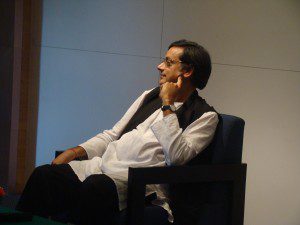
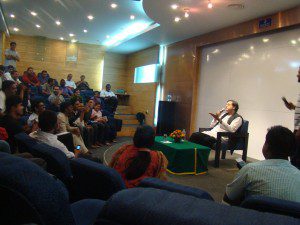
DSC02273 DSC02281

As you can see, he was favouring the right, and the centre, until a lady seated behind me forced him to answer a question from our side. I wondered aloud if he always ignored the left thus, but though my neighbours heard it, sadly he didn’t. I’d have loved a repartee. I noted that we had similar workplace issues, as Twitter was banned in the MEA too. Meanwhile, our friend Nikhil, (who claims he was) one of the voters who elected Mr.Tharoor to the parliament, had a political googly question for him. But he managed to answer it satisfactorily too.

1 2

He talked about occasions when he was asked to explain Twitter to his colleagues, and the advice to him to stop tweeting if he valued his political career. But as he said, he doesn’t like being told he can’t do something. He explained his twitter habits – following, answering questions on Twitter, and the balance he has to maintain while sharing with the world a minister’s life. He was asked about his writing plans, to which he answered that the current job keeps him too busy to write, and not just to write, but to create that space in the mind, which can be populated with people and instances that have nothing in common with his daily life. So for now, The Great Indian Novelist is reduced to the limitations of a git (great indian twitterer) ;) – 140 char.

And thus, thankfully, he didn’t disappoint, and i sat, listening in rapt admiration, as the man displayed his ease with the language, bringing a smile and making us LOL, with witty answers to even the most banal of questions. Yes, there were quite a few of those too. But thankfully there were the opposite kind too, which got him to talk about the working of his ministry, and future plans. I could throw in erudite, polished, confident and similar adjectives as descriptions for him, but a master craftsman is usually beyond adjectives. (as anyone who saw that jaw-dropping 175 would vouch for)

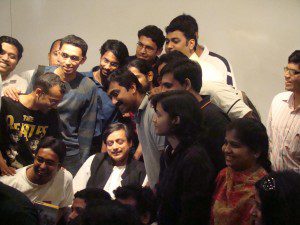
Though he had arrived a bit earlier than announced at the venue (the twitvite said 3, when the actual time was 3.30, but the reason for that is easy to guess, so I wouldn’t complain), we still had only an hour, and it passed very quickly.  But it was undoubtedly, fun!! So, finally everyone posed for photos,

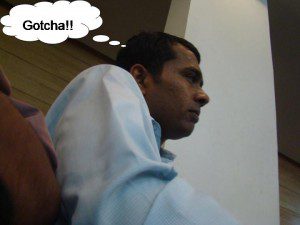
DSC02285(guy in grey-blue striped t-shirt, asked the best questions)
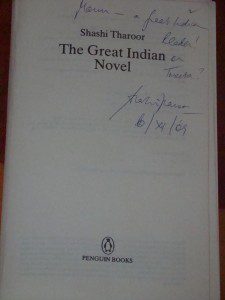
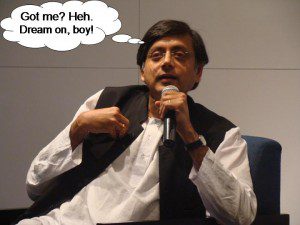
and somewhere in between I accomplished the other thing I’d come for. :) :)

DSC02289

until next time, end of gushy Tharoor post ;)

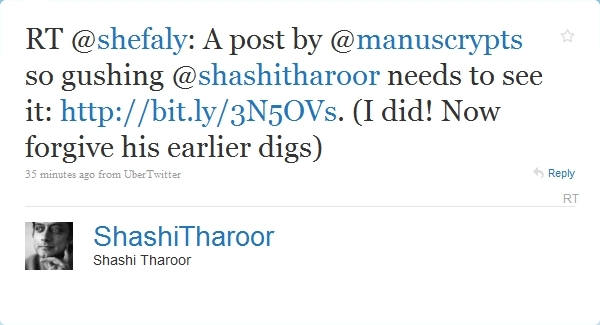
(HUGE) UPDATE

ST RTs !!

1

Kerala Kerala, Quite Contrary

Posted by manuscrypts | Posted in Books | Posted on 30-08-2009

Tags: , , , , , , , , , , , , , , , , , , , , , , ,

4

This is an anthology of 26 works, edited by Shinie Antony, who also contributes a few as author, interviewer and chronicler. The title, IMHO, is a bit misleading since the works themselves, while touching upon various aspects of life in the state or offering perspectives on its history, culture or working as travelogues, do not attempt to bring out the contrary nature, in whatever form that’s meant. Different individuals’ point of view, does that make a collection ‘contrary’? I’m not so sure. To be fair, a couple of works do attempt to show the contrary nature of the state and its residents, but that’s in isolation, and anyway are not enough in number to justify the title.
Having said that, there are quite a few which I immensely liked. Will mention those (in the order in which they appear in the book)
Odd Morning by Susan Visvanathan. I’ve always been a fan of her work after I read ‘Something Barely Remembered’. There’s something that’s wistful and haunting about the way she writes, and this piece follows that style.
William Dalrymple’s “The Strange Sisters of Mannarkad” is quite enlightening, and has a fascinating theme of religion and legend.
Anita Nair’s “Orhan Pamuk, Nair and I” is a wonderful short story that explores the psyche of Kerala’s writers and critics.
“The Argumentative Malayali” by D.Vijayamohan perhaps best justifies the book’s title, as it captures Kerala’s unique stance on global and national issues. As a malayali, I’d say that his observation and insights are spot on. Anti-communist? Probably, but I can’t blame him. For me, its one of the best works in the book.
S S Lal’s “A medicine that cannot be prescribed” is the kind of short story I love. The perfect mix of food for thought and a mild twist in the tale, that makes a perfect ending.
“Sitrep Seventies” by Hormis Tharakan is perhaps the strongest contender for the best work in the book. While I was mildly puzzled by the way the piece started, the way it swept across centuries and the lifestream nature of the work grew on me, and its amazing insights on law and human nature just raised it to a whole new level.
Shreekumar Varma’s “Fort Lines” is a story anyone who has lived in the state, or visited on a ‘wrong day’ can absolutely identify with. I wish the kind of cosmic justice that appeared in the work happened in real life too!!
“No Sex Please, We have cable” by Suresh Menon ended up as my favourite work. The humour is amazing, and I could easily identify the way a place changes or remains the same depending on what you’re looking for.
Nimz Dean, all of 13 years old is the youngest contributor at “The Gift”, and the 2 page work definitely shows promise. :)
Shashi Tharoor uses all of his skills to make a passionate case for Kerala and investments in the state in “Building Brand Kerala”. A well written piece but having lived there most of my life, and having worked there for some and having seen enough hartals in the recent past , I am not convinced.
“Happy” by Omana (as told to Shinie Antony) is amazing food for thought material, and is a fine ending to the book.

So that’s about 11 out of 26, which are really good works, and a few others could work for you depending on your interests. :)

The Five Dollar Smile

Posted by manuscrypts | Posted in Books | Posted on 20-03-2009

Tags: ,

0

Shashi Tharoor

This is a collection of Shashi Tharoor’s early works.. really early :) It has 14 stories and a two act play. While they are not of the fantastic quality of say, The Great Indian novel, it definitely shows the class of the author, who even during school and college days, displayed an affection for words, and humour.
Each story is preceded by a note from the author that explains the context, and the mood. This adds great value to the reading.
The stories range from semi autobiographical to takes on the social, cultural and economic milieu prevalent at the time the story was set, and pure fiction. Some of them are also unique perspectives on commonplace occurrences. A lot of stories reflect the ‘Indian middle class’ values and mindset, and I could identify with that a lot. A lot of the wit is pun driven, so if you’re a wordsmith you’ll like it. :)
The play is a wonderful humorous metaphor on the Emergency.
In essence, a decent read.